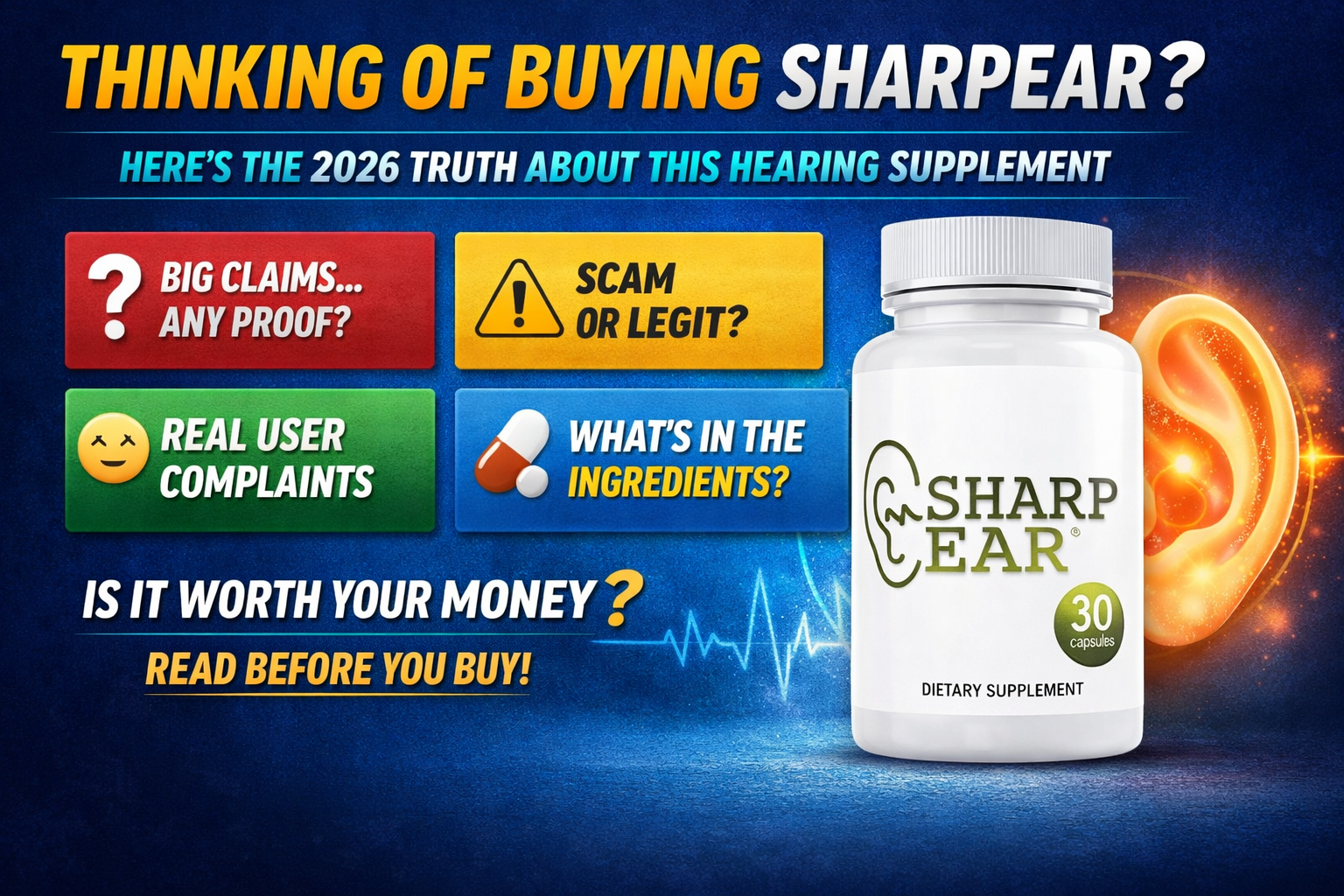
SharpEar Scam or Legit in 2026? Honest Review, Complaints, Ingredients & Real Truth
SharpEar Scam Updates
In short, SharpEar is a nutritional and hearing supplement that you can buy online. There are a lot of affiliate marketing and promotional press releases about it. There is no high-quality clinical study evidence that it recovers hearing, and most of its web presence is for marketing. It is not an FDA-approved medication or medical device. It doesn’t inherently imply it’s a scam, but you should be careful with the claims made about the product, choose proven medical choices when you can, and follow the buyer-safety checklist in this post before you spend any money. (I’ll tell you what SharpEar says, what the evidence really says, how to check if it’s real, what to look out for, other options, and what to do next.
What is SharpEar?
SharpEar is sold as a “all-natural” supplement that is meant to help the health of the inner ear, the function of the auditory nerve, and mental clarity. It is generally offered as a non-surgical option for people who are worried about hearing loss and tinnitus that comes with age.
There are many “official” websites and affiliate pages that sell bottles of capsules at a big discount and provide subscriptions. A lot of the time, the makers and promotional pages will mention a founder’s name (usually “Sam Olsen”) and a list of plant-based ingredients. You’ll encounter websites that are meant to promote the product instead of giving you a lot of scientific information. SharpEar (official site)
A lot of the longer articles you discover are press releases, affiliate reviews, or marketing content that has been repeated. They are not impartial lab results or peer-reviewed clinical trials. Examples go back to 2020–2021 and then come back with fresh “2024/2025/2026” banners on SEO sites.
The claims SharpEar makes
Some common marketing claims are:
- Repairs damage to the inner ear and nourishes auditory nerves.
- There are no adverse effects with 100% natural substances.
- Quick increases in hearing clarity, less ringing in the ears, and better brain function.
- Made in a GMP facility in the U.S. and “quality tested.
These are common claims made by supplement companies: they are vague, hopeful, and worded to sound like a medical solution without giving any specific clinical evidence or the size of the benefit. Testimonials and stories of what happened before and after using the product are highlighted on the product pages themselves.
Ingredients : What’s actually in the formula?
Affiliate sites and product pages often mention combinations of herbs and nutrients that are commonly used in selling “hearing supplements.” Different sources often list these types of ingredients:
Ginkgo biloba is commonly talked about for its effects on circulation and brain function.
Passionflower, Corydalis, and St. John’s Wort are some of the herbs that are sometimes added to these blends to help calm the nerves.
Huperzine A is a cholinesterase inhibitor that is sometimes used in cognitive stacking.
Antioxidants and B-vitamins (B12 and folate), and sometimes magnesium or other minerals.
There is no single standardized public label for these products that a regulator checks, like there is for prescription drugs. varying vendor pages disclose somewhat varying blends and ingredient ordering. That kind of difference is normal for supplements that are mostly offered directly to consumers.
What the ingredients mean for effectiveness: Some ingredients, like Ginkgo biloba or B-vitamins, don’t have strong scientific evidence that they work in certain cases.
However, none of the ingredients listed have strong, reproducible, high-quality clinical evidence that they can restore hearing loss in the same way that a medical device or surgery can.
A few tiny studies or mixed observational reports are not enough to prove that the product “repairs the inner ear.” If a supplement says it can “restore” hearing, ask for randomized, double-blind, placebo-controlled scientific trials that assess hearing thresholds and functional outcomes. SharpEar doesn’t seem to offer any public evidence of this.
Evidence: is there clinical proof SharpEar works?
Short answer: SharpEar’s marketing typically suggests that there is strong, peer-reviewed clinical data to back up their claims about restoring hearing.
We do discover online:
- Press releases and affiliate reviews that list the alleged benefits (not original trials).
- Marketing blurb on sites that imitate each other’s work.
- Commercial platforms have product listings and user reviews. These can be real, but they are often mixed up with reviews that are paid for or not verified.
We do not identify a publicly available, high-quality randomized clinical trial demonstrating clinically significant hearing improvement due to SharpEar. On the other hand, the main scientific literature and major health organizations say that hearing aids, cochlear implants, and sometimes even procedural procedures are the best approaches to improve hearing.
The U.S. Food and Drug Administration (FDA) and the U.S. National Institute on Deafness and Other Communication Disorders (NIDCD) give advice on hearing aids, over-the-counter hearing aids, and medical equipment. They do not give advice on herbal medicines that “repair” hair cells in the inner ear.
Safety: are there side effects or risks?
Because SharpEar and other comparable supplements blend a lot of different plants and chemicals, safety is a concern.
- Interactions between drugs. Some ingredients, such St. John’s Wort, Ginkgo, or huperzine A, can interact with prescription medicines like antidepressants, blood thinners, and cholinergic drugs.
- Different levels of quality. Supplements aren’t controlled the same way that prescription pharmaceuticals are. The amount and purity of the ingredients can change from batch to batch or seller to seller.
- Side effects that could happen. Marketing often says “no side effects,” but that doesn’t mean the product is safe to use. People can still experience allergic reactions, problems with their stomach, or interactions between herbs and drugs.
Talk to a doctor before taking any supplements if you take prescription drugs, blood thinners, or have a long-term illness. If a product label states “100% natural—no side effects” yet doesn’t warn you about interactions, it should be a red flag, not a sign of safety. (See the Federal Trade Commission and healthcare agencies’ official recommendations for consumers on how to recognize false health claims.)
Scam Risk: what to look for?
“Scam” might mean a lot of things, such bogus reviews, false clinical claims, unrealistic return policies, or costs that aren’t real. Here’s how things usually go with SharpEar and why a lot of folks are worried:
Things that make you suspicious
Many “official” websites and affiliate pages that are very similar to each other. Some SharpEar websites and affiliate review pages utilize the same marketing materials, which makes it look like there is an affiliate marketing ecosystem instead of a clear single manufacturer. This happens a lot with popular pills, but it makes them harder to trace.
A lot of testimonials and press releases instead of clinical facts. Be careful when marketing puts more weight on stories than facts.
Strong “limited time” discounts and subscription funnels. Many DTC supplement pages utilize big “today only” discounts to get people to buy things on the spot. That’s a business strategy, not necessarily fraud, but it’s crucial to read the policy on refunds and subscriptions carefully.
There is no recognizable, verified information about the manufacturer. Legitimate businesses will clearly list the manufacturer’s legal name, address, third-party lab test results, and a way for customers to contact them by phone or email. If the site is unclear or doesn’t include contact information, that’s a bad sign.
There are no peer-reviewed clinical trials mentioned. Be careful with a product that says it can “repair” tissue or restore function but doesn’t show any controlled trials.
Things that make it less likely that you’ll get scammed (but don’t prove it)
The product is available on large retail sites like Amazon. This shows that it is widely available, but not that it has been clinically tested.
The vendor says they use GMP manufacturing, which is possible but not the same as clinical proof. You should check the details of the facility and the certificates for third-party testing.
In general, SharpEar has a lot in common with real DTC supplement companies, but it also does a lot of things that make people wary of its marketing. That mix makes it more probable that the supplement is a marketing-driven one (buyer beware) instead of a full-on criminal scam. However, there are still actual hazards for consumers, such as charge traps, low product value, or false health claims.
How to verify a supplement (quick checklist before you buy)
Use this step-by-step list if you are thinking about SharpEar or any other hearing supplement:
- Look at the label on the product. You should be able to see the ingredients, the dosages, and the list of “other ingredients.” Look at the label and what the marketing says.
- Look for lab reports from outside sources (COA). Good producers often give out Certificates of Analysis from independent labs that show the product’s purity and heavy-metal testing. If none are given, ask for them.
- Make sure the firm name, address, and phone number are all clear. If you can, check such facts with business registries. Caution is only needed with vague contact forms.
- Look for reviews that aren’t on the product pages. Verified buyers on big sites and in forum conversations can be more honest, but watch out for bogus reviews.
- Look at the conditions for returns and refunds, as well as how to cancel your subscription. Look at the fine print. Some funnels sign you up for regular delivery until you want to opt out.
- Talk to your doctor. Especially if you take medicine, have a medical condition, or suffer hearing loss that affects your everyday life.
If you have measurable hearing loss, you should choose evidence-based paths. Look at the following section for other options.
Practical buyer advice: if you want to try SharpEar
If you still want to try it after the checklist:
- Don’t stop using approved gadgets or therapies that your doctor has told you to use. Unless a doctor says otherwise, supplements should only be used as extras, not replacements.
- Don’t sign up for a multi-bottle subscription right away; buy one bottle first. Check for recognized side effects and see if you detect any changes.
- Keep all receipts and notes of conversations with the vendor in case you need to get your money back or disagree with the charges.
Be careful of subscription traps. If you discover illegal charges that keep happening, call your bank or card provider right away. The FTC contains information for consumers on how to dispute charges that weren’t approved.
Real alternatives that have evidence
Here are some choices that are backed by research that you should think about first if you want to significantly improve your hearing or lessen your tinnitus:
Visit an ENT or audiologist. Get a hearing test (audiogram) that is right. That tells you what kind of hearing loss you have and how bad it is, as well as the right treatment.
Think about getting hearing aids or over-the-counter (OTC) hearing aids. In 2022, the U.S. FDA developed an over-the-counter (OTC) hearing aid category to make it easier for those with mild to moderate hearing loss to get these devices. These devices are regulated as medical devices and have explicit performance parameters. A supplement is not likely to help if you have quantifiable hearing loss, but an over-the-counter or prescription hearing aid is much more likely to help.
Cochlear implants and implantable devices for more severe loss are medical procedures that have solid proof for severe/profound instances.
Cognitive behavioral therapy (CBT) and sound therapy are two types of therapy that can help with ringing in the ears.
Lifestyle and preventative measures include avoiding loud noises, using hearing protection in loud places, managing cardiovascular risk factors (which alter blood flow to the inner ear), and only correcting vitamin and mineral deficiencies when a doctor notes them.
In short, medical equipment and clinical care are the best ways to treat most hearing disorders. Supplements are not as good and are not frequently supported as “fixes” on their own.
So… SharpEar Scam or Legit ?
Is it a scam? SharpEar does some things that look like scams, like having a lot of fake reviews, using a lot of aggressive discounting, and making promises that aren’t backed up by clinical evidence. That makes it more likely that customers will be unhappy and lose money (subscription traps, low value).
Is it Legit? It is probably a real commercial supplement that web marketers are selling (not a group of criminals who don’t follow the law). It does exist on retail sites and in press releases. But “legitimate” here just indicates that it’s a real product or business, not that it lives up to its biggest medical claims.
In short, think of SharpEar as a supplement with a lot of marketing and medical claims that haven’t been validated. If you need your hearing for employment, safety, or relationships, the first thing you should do is get a clinical hearing test and buy equipment or therapies that have been shown to help.